
Parent Guide
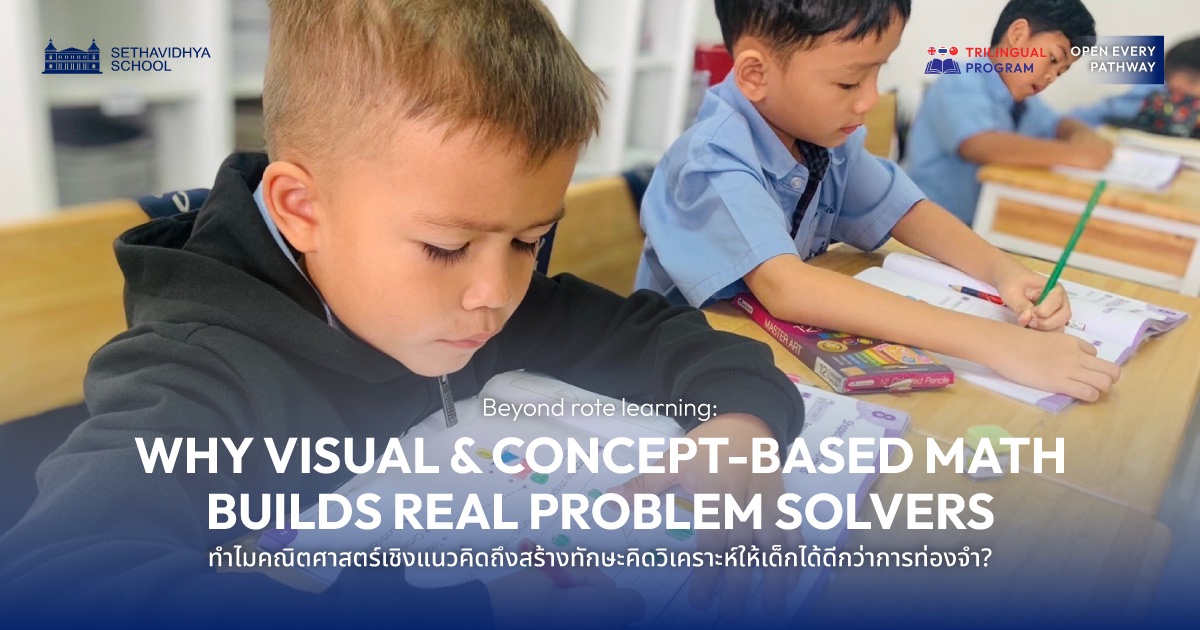
Beyond Rote Learning: Why Visual & Concept-Based Math Builds Real Problem Solvers
For generations, primary mathematics was often taught as a mechanical exercise: memorizing formulas, drilling multiplication tables, and calculating numbers without understanding the context. In an AI-driven era where machines calculate instantly, the goal of primary mathematics must pivot from computational speed to Critical Thinking and Logical Problem Solving.
This pedagogical evolution explains why parents researching international frameworks and progressive methods (such as those aligned with Singapore Math Thailand search trends) are seeking schools that emphasize visual mastery and conceptual depth over passive memorization.
3 Pillars of Concept-Based Mathematical Mastery
1. The Concrete-Pictorial-Abstract (CPA) Approach
Concept-based mathematics guides students through a structured cognitive transition:
- Concrete: Handling physical manipulatives, blocks, and counters to tangibly experience quantity and spatial relationships.
- Pictorial: Visualizing problems through bar models, charts, and diagrams to structure mathematical logic visually.
- Abstract: Formulating mathematical equations and symbols only after deep conceptual understanding is established.
2. Internationally Recognized Marshall Cavendish Academic Materials
At Sethavidhya School, core subjects are taught in English following the Thai Ministry of Education curriculum standards. We utilize globally recognized academic materials from Marshall Cavendish, renowned for fostering analytical inquiry and real-world application. This rigorous conceptual grounding empowers our students to consistently achieve O-NET examination scores above the national average.
3. Active Learning: Transforming Math into an Engaging Experience
Recognized as the “Best Active Learning School” at the World School Summit (selected from 200+ schools across 45+ countries), we transform mathematical concepts into collaborative group activities, hands-on experiments, and interactive problem-solving games. This active approach encourages children to embrace trial and error, overcome fear of mistakes, and find joy in discovering solutions independently.
Personalized Guidance in Small Class Sizes (~8:1)
Every child develops mathematical intuition at their own pace. Maintaining an optimal average ratio of about 8 students per teacher (~8:1) ensures educators can provide individualized feedback, celebrate breakthroughs, and support each learner from Pre-School through Primary 6.
Empowering Thinkers to Open Every Pathway:
Mathematics is the language of logic. When children master visual problem-solving, they gain the lifelong adaptability and critical thinking required to excel in any future academic or career pathway.
Experience Concept-Based Active Learning at Sethavidhya School Hua Hin
We invite parents to visit our classrooms, meet our academic leadership, and observe our visual math methods in action.
(Office Hours: Monday – Friday, 08:00 – 17:00)
Contact our admissions team today to inquire about enrollment or schedule a personalized school tour!